
EUnetCCC designates the first 30 Comprehensive Cancer Centres across 8 countries
Greater equity in care for 2.6 million Europeans diagnosed with cancer every year, regardless of where they live
EUnetCCC designates the first 30 Comprehensive Cancer Centres across 8 countries
The European Network of Comprehensive Cancer Centres (EUnetCCC) designates the first 30 Comprehensive Cancer Centres, marking an important step towards more coordinated, equitable and accessible cancer care across Europe.
By formally connecting reference centres within a shared European framework, this initiative strengthens cooperation between national health systems and promotes better coordination of cancer care, with closer links between treatment and research and fairer access to high-quality oncology services across regions and countries.
EU-Designation follows a population-based approach, respecting national contexts and the organisation of healthcare systems. Rather than creating new institutions, it recognises centres, or consortia of centres, that already play a central role in organising cancer care and research for defined populations. In several countries, this has led to the development of inter-regional models or consortia under shared governance.
“This first group of EU-Designated Comprehensive Cancer Centres represents a fundamental step towards building a more coordinated and equitable European cancer landscape. By recognising centres that already play a structuring role at national level and connecting them through EUnetCCC, we are laying the foundations for lasting impact for patients across Europe,” said Thomas Dubois, Head of European and International Affairs at the French National Cancer Institute and EUnetCCC Coordinator.
What does EU-Designation mean in practice?
In practice, the process starts at national level, with centres identified and endorsed by national health authorities, in coordination with Ministries of Health, before applying for EU-Designation.
It represents a first European recognition of nationally designated Comprehensive Cancer Centres and identifies centres that demonstrate an adequate level of integration in cancer care and are well positioned to progress along the EU CCC certification pathway.
Applications are assessed by the Designation and Admission Committee (DAC) of the EUnetCCC Joint Action. EU-Designation does not constitute a quality certification or accreditation.
EU-Designation Label
From designation to long-term impact
EU-Designation is a starting point.
Centres holding the designation label enter a structured pathway of continuous improvement and benefit from EUnetCCC activities, which include:
- Capacity-building to strengthen governance, organisation and quality management;
- Structured cooperation, peer learning and support for clinical and translational research;
- Tools and frameworks to enhance integration and innovation and to strengthen connections with the wider European cancer ecosystem.
This pathway strengthens the maturity of centres in delivering high-quality, fully integrated cancer care to entire populations, serving as the starting point for building a cohesive European network and contributing, over time, to greater equity in care for the approximately 2.6 million Europeans diagnosed with cancer each year.
List of the 30 EU-Designated Comprehensive Cancer Centres
| Country | Organisation |
|---|---|
| Belgium | Cliniques Universitaires Saint-Luc |
| Belgium | UZ Antwerp |
| Belgium | UZ Brussels |
| Belgium | UZ Gent |
| Czech Republic | Masaryk Memorial Cancer Institute |
| France | AP-HP |
| France | GCS HUGO |
| France | GCS NOVA |
| France | GCS HOURAA |
| Lithuania | Klaipeda University Hospital (KUL) |
| Lithuania | Vilnius University Hospital Santaros Clinics and National Cancer Centre (branch of Santaros Clinics) (VUL SK) |
| Lithuania | Hospital of Lithuanian University of Health Sciences Kaunas Clinics (LSMUL KK) |
| Luxembourg | Luxembourg Comprehensive Cancer Center |
| Norway | St. Olav University Hospital |
| Norway | University Hospital of Northern Norway (UNN) |
| Romania | Institutul Oncologic "Prof. Dr. Ion Chiricuta" Cluj-Napoca (IOCN) |
| Spain | CCC Euskadi - Basque Country |
| Spain | Regional University Hospital of Malaga |
| Spain | Hospital Universitario Virgen del Rocio (HUVR) |
| Spain | Hospital Reina Sofia |
| Spain | CICCAR (Comprehensive Cancer Center - Cantabria and La Rioja alliance) |
| Spain | Complejo Asistencial Universitario de Salamanca |
| Spain | Servicio Murciano de Salud |
| Spain | Hospital Universitario y Politecnico La Fe |
| Spain | Comprehensive Cancer Network of Aragon |
| Spain | ASTUR-CCC |
| Spain | Galician Comprehensive Cancer Centre |
| Spain | Hospital del Mar |
| Spain | Hospital Universitario de Navarra HUN |
| Spain | Nord Catalunya Consorci Oncologic Integral |
EUnetCCC: an initiative of Europe's Beating Cancer Plan
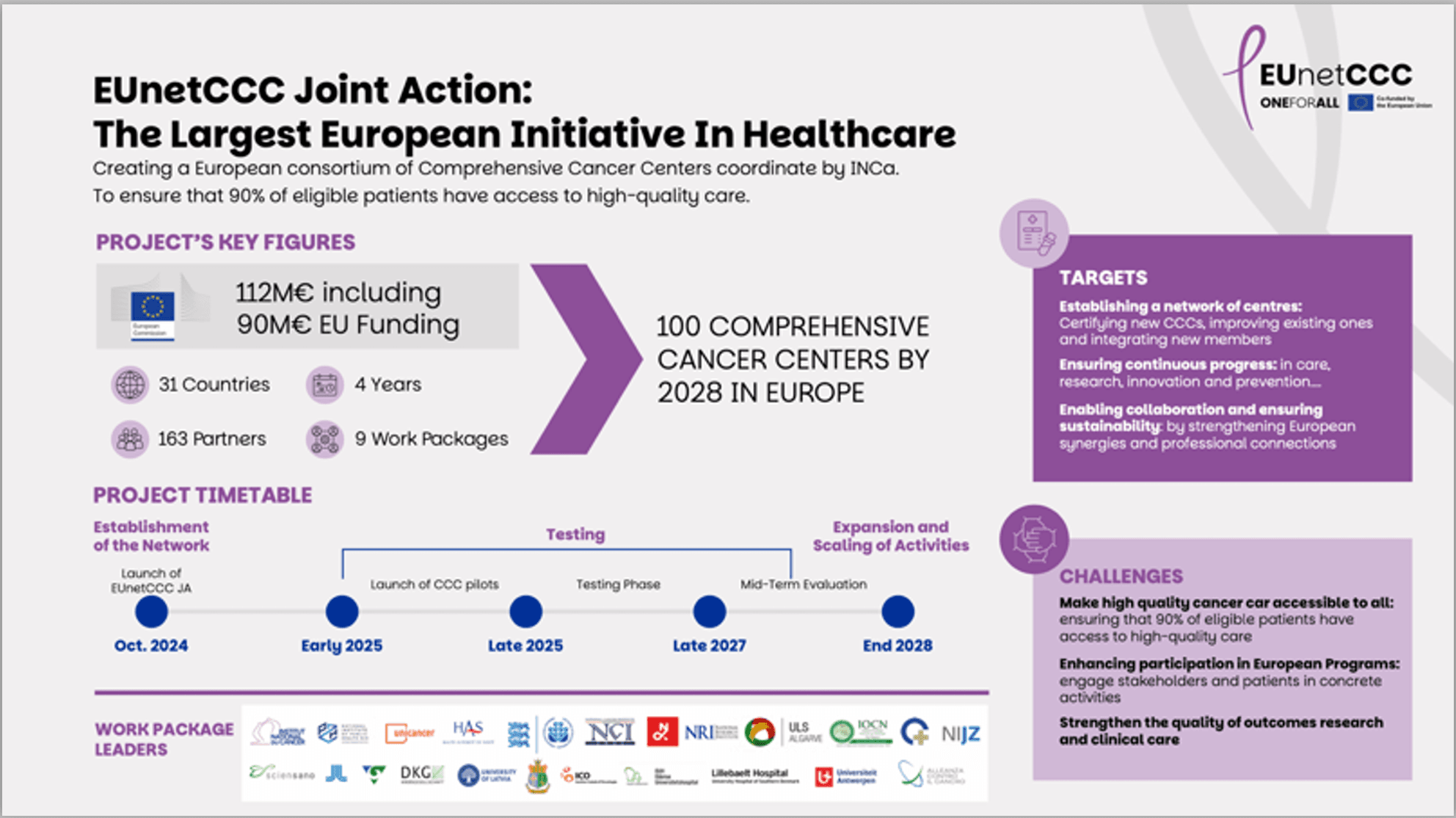
The EUnetCCC is a Joint Action coordinated by the French National Cancer Institute (INCa). It is an initiative under Europe's Beating Cancer Plan, the European Union's unprecedented political and financial commitment, with a budget of EUR 4 billion, to reduce the cancer burden and associated inequalities across Europe.
The initiative supports a structured, population-based approach to cancer care, research and innovation, anchored in national health systems and strengthened through European cooperation. Established as Flagship Action No. 5 of the Plan, EUnetCCC aims to build a coherent European network of Comprehensive Cancer Centres (CCCs) capable of translating clinical and scientific excellence into tangible benefits for patients and populations.
What are Comprehensive Cancer Centres - and why do they matter?
Comprehensive Cancer Centres (CCCs) are organisations that integrate, within a defined territorial scope:
- Cancer prevention and early detection;
- Diagnosis and treatment;
- Clinical and translational research;
- Education and training;
- Innovation and data-driven approaches.
Beyond excellence at the level of individual institutions, CCCs play a structuring role within national cancer control systems, ensuring that innovation is systematically integrated into care and that high-quality oncology services are accessible to entire populations.
Scaling up towards a European network of 100 Comprehensive Cancer Centres
The designation of the first 30 Comprehensive Cancer Centres represents the first wave of implementation.
A second wave, with the objective of reaching around 100 Comprehensive Cancer Centres across Europe by 2028, is underway, in line with the ambitions of Europe's Beating Cancer Plan.
Communication EUnetCCC: Sofia Coelho Silva, +351 91 487 69 64