
On Friday 16 October 2026, patients, cancer survivors, families, healthcare professionals and citizens will gather in Unirii Square, Cluj-Napoca, to form a human ribbon dedicated to cancer. The initiative, One Ribbon. Many Stories, is organised by the Oncology Institute “Prof. Dr. Ion Chiricuță” (IOCN), the Cancer Free Future Association and Cluj-Napoca City Hall, with EUnetCCC.
The event starts at 12:00 with the distribution of pink T-shirts, followed at 12:30 by a panel moderated by Dr Delia Nicoară on how an image can become a symbol of the community. At 13:00, participants will form the human ribbon, transforming a familiar symbol into a collective expression of solidarity.
The event is free and open to everyone: cancerfreefuture.eu/one-ribbon.
For IOCN, the ribbon is a starting point. “Awareness alone cannot overcome structural inequalities, improve fragmented care pathways or guarantee appropriate support for people living with and beyond cancer,” writes Dr Delia Nicoară, Public Health and Management Specialist at IOCN.
For awareness to have lasting value, it must be connected to evidence-based prevention, accessible healthcare services, effective coordination between professionals and meaningful patient involvement.
This is where IOCN’s European work comes in. Within EUnetCCC Work Package 8 – Network Activities, the institute contributes to activities addressing personalised cancer prevention, cancer survivorship and the sharing of practical knowledge between centres.
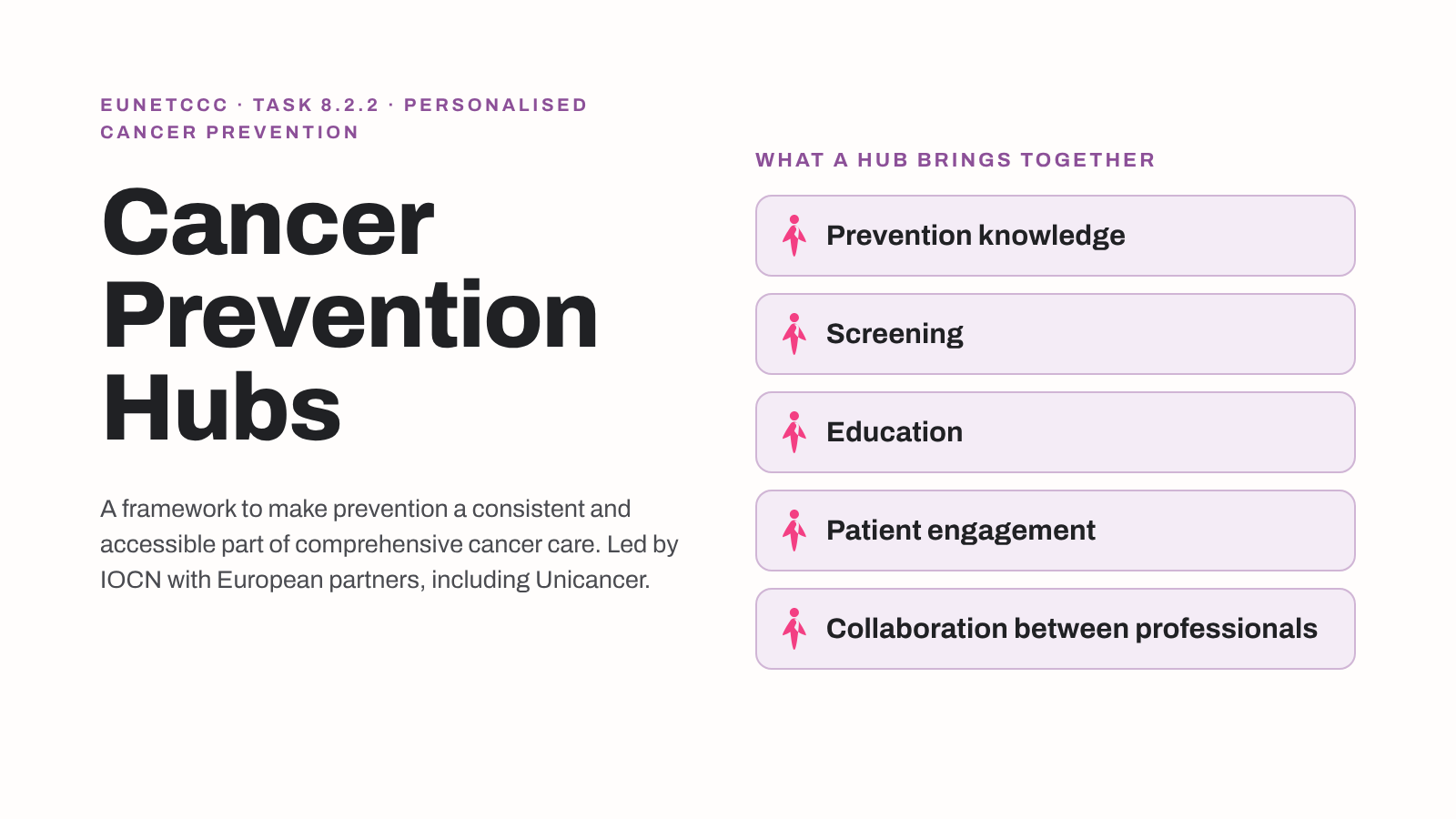
Through Task 8.2.2 – Personalised Cancer Prevention, led by IOCN in collaboration with European partners including Unicancer, EUnetCCC is developing a framework for Cancer Prevention Hubs. The hubs are intended to bring together prevention knowledge, screening, education, patient engagement and collaboration between healthcare professionals within Comprehensive Cancer Centres.
One example of translating evidence into accessible patient information is IOCN’s guide Your Recovery Step by Step: Safe Movement During and After Breast Cancer Treatment, developed in the framework of Task 8.2.2 and JANE-2 WP8, with knowledge exchange with Centre Léon Bérard in France.
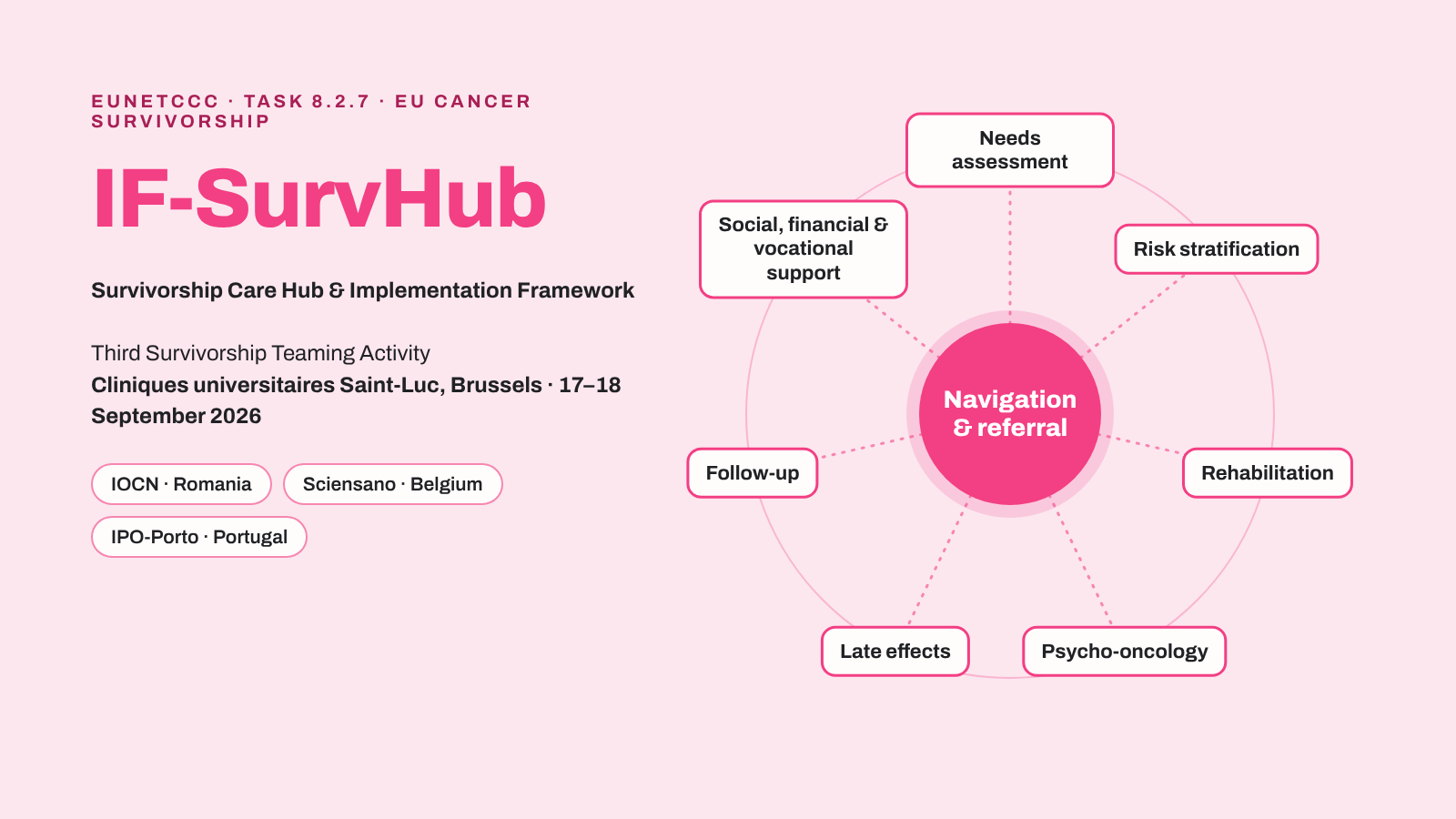
Survivorship is the second focus. Task 8.2.7 – EU Cancer Survivorship, which involves IOCN, Sciensano in Belgium and IPO-Porto in Portugal, treats survivorship care as extending across the cancer continuum, from diagnosis onwards. On 17–18 September 2026, partners met at Cliniques universitaires Saint-Luc in Brussels for the third Survivorship Teaming Activity and advanced IF-SurvHub, a common Survivorship Care Hub and Implementation Framework. It covers needs assessment, risk stratification, rehabilitation, psycho-oncology, late effects, follow-up, and social, financial and vocational support, with navigation and referral at its centre. The framework is still being developed and consolidated.
Patients are partners in this work. Within Task 8.2.7, the proposed implementation framework includes plans to involve patient representatives as co-chairs of Thematic Working Groups. In July 2026, the WP8 video series Voices from the patient community featured Andreea Breaz, a patient representative at IOCN, and Miguel Reis, a cancer survivor and member of the Patient Advisory Council at IPO Porto. “Patient-centred care cannot be defined solely by healthcare professionals. It must also be informed by the people who experience that care,” Dr Nicoară writes.
The conversation continues at the EUnetCCC Annual Meeting in Lisbon on 26–27 November 2026. Dr Delia Nicoară’s full article, Beyond the Ribbon, is available in the EUnetCCC LinkedIn newsletter.