EUnetCCC at EUPHA 2026: public health at the heart of Comprehensive Cancer Centres
At EUPHA 2026, the 19th European Public Health Conference organised by the European Public Health Association (EUPHA) in Bilbao, Spain, the National Institute of Public Health of Slovenia (NIJZ) and the Institute of Oncology Ljubljana presented how public health can be built into Slovenia’s emerging consortium-based Comprehensive Cancer Centre (CCC), within the framework of the EUnetCCC Joint Action.
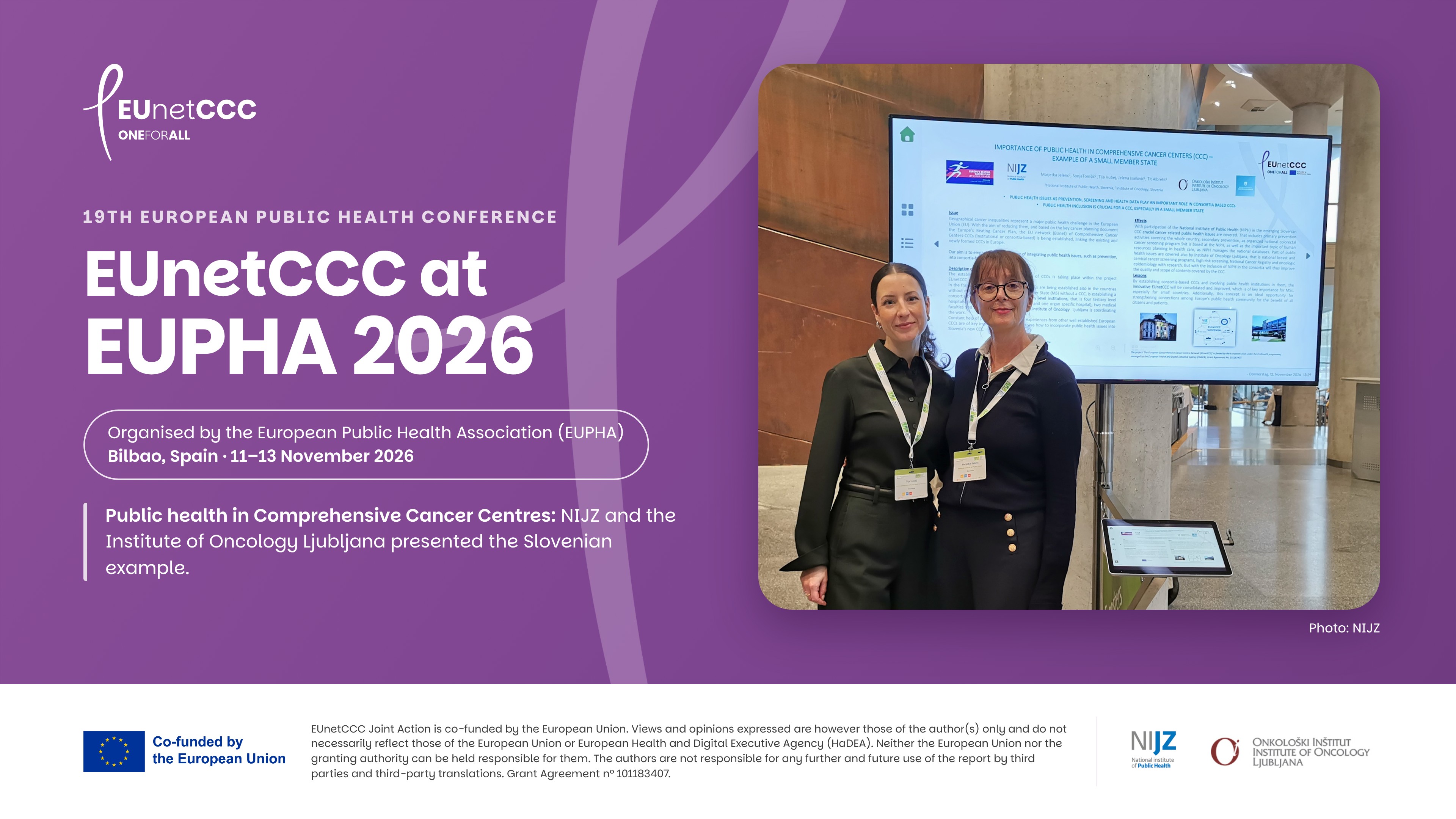
The conference took place from 11 to 13 November 2026 at the Euskalduna Conference Centre. Europe’s leading annual public health gathering brought together researchers, policymakers, practitioners and educators from across Europe and beyond to share scientific evidence and good practice, and to bridge the gap between public health research, policy and practice. This year’s main theme focused on urban and global synergies: “Shaping the future of public health with climate resilience, equity and innovation”.
The Slovenian example
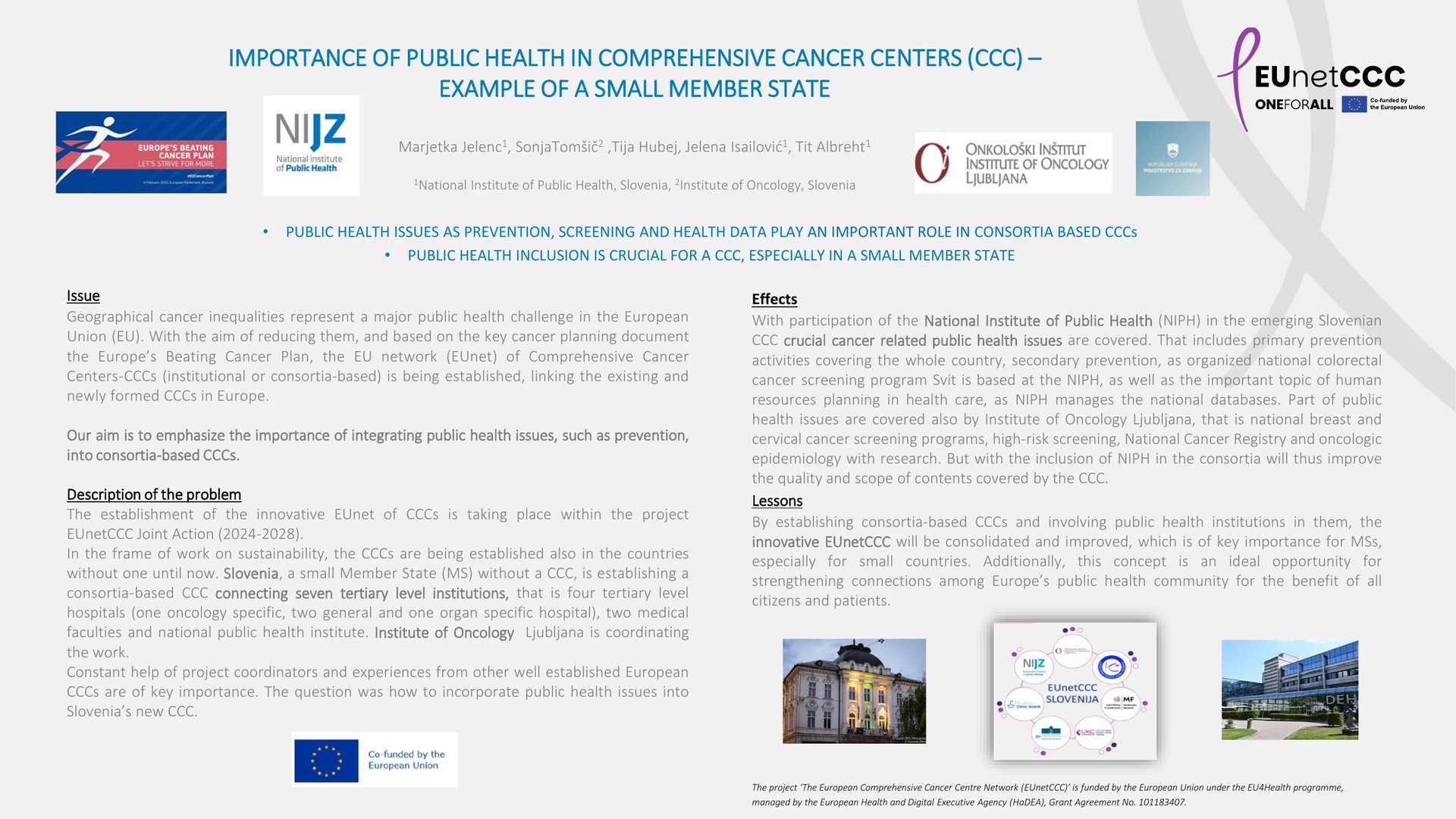
The poster “Importance of public health in Comprehensive Cancer Centers (CCC) – example of a small Member State” was authored by Marjetka Jelenc, Sonja Tomšič, Tija Hubej, Jelena Isailović and Tit Albreht, from NIJZ and the Institute of Oncology Ljubljana.
Geographical inequalities in cancer remain a major public health challenge in the European Union. To help reduce them, and building on Europe’s Beating Cancer Plan, EUnetCCC is establishing an EU network of CCCs – both institutional and consortium-based – linking existing and newly formed centres across Europe. As part of the work on sustainability, CCCs are also being set up in countries that do not yet have one.
Slovenia is one of them. As a small Member State without a CCC, it is building a consortium-based CCC that connects seven institutions: four tertiary-level hospitals (one oncology-specific, two general and one organ-specific), two medical faculties and the national public health institute. The work is coordinated by the Institute of Oncology Ljubljana. The authors highlighted the constant support of the project coordinators and the experience of well-established European CCCs as key to the process.
What public health brings to a CCC
With NIJZ on board, the Slovenian CCC covers crucial cancer-related public health areas: primary prevention activities across the whole country; secondary prevention, as the organised national colorectal cancer screening programme Svit is based at NIJZ; and human resources planning in healthcare, as NIJZ manages the national databases. The Institute of Oncology Ljubljana covers other public health areas, including the national breast and cervical cancer screening programmes, high-risk screening, the National Cancer Registry, and oncological epidemiology and research.
Key messages
- Public health areas such as prevention, screening and health data play an important role in consortium-based CCCs.
- Including public health is crucial for a CCC, especially in a small Member State.
- Involving public health institutions in consortium-based CCCs strengthens EUnetCCC – which is of key importance for Member States, especially small countries – and helps connect Europe’s public health community for the benefit of all citizens and patients.
Reference: Jelenc M, Tomšič S, Hubej T, Isailović J, Albreht T. The importance of public health in comprehensive cancer centers – An example from a small member state. European Journal of Public Health. 2026;36(Suppl 5):v744. Available at: https://academic.oup.com/eurpub/issue/36/Supplement_5